Seasonal Home Care
How to Choose a Leaf Blower for a Small Yard
A good leaf blower for a small yard should be easy to handle, easy to store, and capable of clearing the surfaces and debris you actually have. Compare power source, airflow control, runtime or cord reach, noise, and total ownership costs before buying.
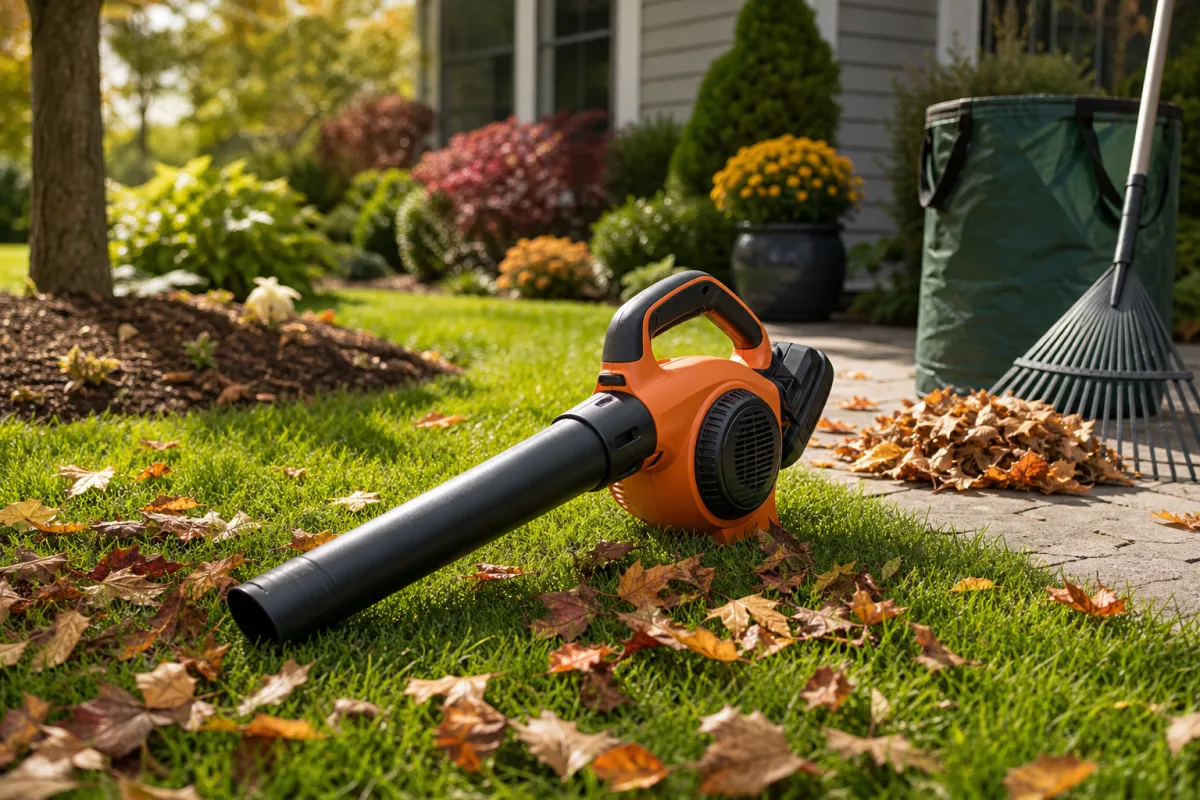
A small yard rarely needs the biggest leaf blower on the shelf. For many homeowners, a lighter tool with controllable airflow, practical storage, and a convenient power source is a better match than maximum output.
Start with your cleanup routine—not a headline CFM or MPH number. The right leaf blower depends on where leaves collect, whether debris is dry or damp, how close your neighbors are, and whether you want to simply move leaves or collect and mulch them.
Start With Your Actual Cleanup Needs
A compact lawn with a few trees has very different needs from a similarly sized lot with mature trees, a long driveway, patios, fence lines, and landscaped beds. Consider the work you expect the blower to do most often.
- Tree coverage and cleanup frequency: More trees generally mean more frequent cleanup and larger leaf piles.
- Surfaces: Driveways, sidewalks, decks, and patios are usually easier to clear than grass.
- Landscaping: Mulch beds, decorative stone, and flower borders benefit from gentle, adjustable airflow.
- Debris: Dry leaves are easier to move than damp leaves, stuck grass clippings, or soil.
- Storage and access: Consider available space plus access to an appropriate outdoor outlet if you are considering a corded model.
This kind of right-sizing helps avoid buying a tool that is heavier, louder, or more cumbersome than your regular tasks require.
Choose the Right Power Type
For most small yards, cordless battery and corded electric blowers are the most practical starting points. Gas models may still fit some situations, but their fuel, maintenance, noise, and storage demands deserve careful consideration.
| Power type | Choose it when | Main tradeoff |
|---|---|---|
| Cordless battery | You want easy movement between lawn, driveway, and backyard without an extension cord | Runtime is limited by the battery and operating speed |
| Corded electric | Your work area is reliably within safe reach of a suitable outdoor outlet | The extension cord must be managed around landscaping and obstacles |
| Gas | Debris volume, operating duration, or site conditions truly exceed what your preferred electric option can handle | Fuel handling, engine maintenance, storage, and noise add complexity |
Cordless: best for mobility and routine touch-ups
Cordless blowers are convenient for small yards because there is no cord to route around trees, gates, vehicles, and beds. They are often a good fit for quick weekly cleanup of walkways, patios, porches, and light leaf cover.
Before buying, confirm whether the listed price includes a battery and charger. Some models are sold as bare tools for people who already use that brand’s battery platform. Also check expected runtime at the speed you expect to use, since high or boost settings can shorten it.
A second battery can be useful if your fall cleanup regularly lasts longer than one charge or if you prefer not to pause for recharging.
Corded electric: best for dependable nearby-outlet use
A corded blower can be a good-value choice when your cleanup area is close to a suitable outdoor outlet. It can run continuously while connected, without battery charging or refueling.
The practical question is whether an outdoor-rated extension cord can safely reach the areas you need to clear. Cord routing may be inconvenient around trees, garden beds, vehicles, gates, and steps. Follow the blower manufacturer’s instructions for cord type and use.
Gas: consider only when the extra demands are justified
Gas-powered blowers may be worth considering for unusually heavy, frequent, or extended cleanup work. On a typical small property, however, they can add more maintenance and storage work than necessary.
If you are considering gas, factor in fuel handling, routine engine care, off-season storage, noise, local rules, and the space needed to store fuel and equipment appropriately.
Compare Airflow Without Chasing One Number
Leaf blower listings commonly show CFM and MPH, but those figures describe different parts of airflow.
- CFM (cubic feet per minute) indicates air volume. It can be useful for moving a wider mass of loose leaves.
- MPH (miles per hour) indicates air speed. It can help lift debris from cracks, corners, and textured surfaces.
For a small yard, compare CFM and MPH alongside nozzle design, speed settings, and the kinds of debris you need to move. Maximum ratings should not be treated as a complete, directly comparable measure of real-world performance across every brand or model; testing conditions and tool design can differ.
Match airflow to your surfaces
- Concrete, asphalt, decks, and patios: Moderate, controllable airflow is often enough for leaves, dust, and clippings.
- Grass: Leaves caught in longer grass or made heavy by moisture may need more air volume and patience.
- Mulch beds and flower borders: Lower settings help reduce the risk of scattering mulch or disturbing plants.
- Gravel and decorative stone: Use gentle settings and careful nozzle positioning to avoid moving the ground cover.
- Corners and fence lines: A focused nozzle can help direct debris out of tight spots.
Variable speed is especially useful for small yards with both hard surfaces and delicate landscaping. Look for a variable-speed trigger, dial, or selectable settings rather than assuming maximum power is always beneficial.
Prioritize Handling, Storage, and Controls
Short, frequent cleanup sessions are common in small yards, so comfort can matter as much as raw output. Compare these practical details:
- Weight and balance: A lighter, well-balanced tool is generally easier to use one-handed.
- Grip and controls: The handle and trigger should be comfortable without requiring you to change your grip.
- Speed control: Adjustable output makes it easier to work near mulch, plants, and gravel.
- Nozzles: Concentrator or tapered nozzles can improve control along edges and in corners.
- Storage shape: Removable tubes, hanging points, and compact bodies can make a difference in a crowded shed, garage, or utility closet.
Measure the storage space before buying if room is limited. A blower that fits your routine and your storage area is more useful than one with extra capability that makes it awkward to keep accessible.
Check the Complete Cordless Setup
For cordless models, the tool itself is only part of the purchase. Review the complete battery setup before comparing prices.
What to verify
- Whether a battery and charger are included
- Battery capacity and compatible battery sizes
- Expected runtime at typical operating settings
- Charging time and charger type
- Price and availability of spare or replacement batteries
- Compatibility with other tools you already own
Runtime changes with speed setting, debris conditions, temperature, battery condition, and how continuously the blower is used. One battery may be enough for light maintenance on a small yard, while a spare battery may make larger fall cleanups more convenient.
If you already own compatible outdoor power tools, staying on the same battery platform can reduce the number of chargers and battery types you need to store.
Think About Noise and Local Requirements
Noise matters in closely spaced neighborhoods, townhome communities, and shared outdoor areas. Review manufacturer-provided noise information when available, but compare it cautiously: stated values may reflect different test conditions and may not predict exactly how a tool will sound at your property.
A blower that clears routine debris effectively at a lower setting may be a more neighbor-conscious choice than one that needs to run at maximum output for every task.
Before using any outdoor power equipment, check applicable:
- Municipal or county rules
- Seasonal and time-of-day restrictions
- Homeowner association requirements
- Community restrictions related to noise or gas-powered equipment
Decide Whether Vacuum and Mulching Features Are Useful
A blower-only model is often the simplest choice if you want to push leaves into piles for raking, bagging, curbside collection, or composting. It may also be lighter and easier to use.
Blower/vacuum/mulcher combinations can be useful when you want to collect leaves and reduce their volume before disposal or composting. Still, extra functions are not automatically better for every small yard.
Ask these questions before choosing a combination tool:
- How difficult is it to switch between blower and vacuum modes?
- Is a collection bag included, and is it large enough for your cleanup routine?
- How easily can the bag, tube, and impeller area be emptied and cleaned?
- Will damp leaves or mixed debris cause clogs or add cleanup work?
- Does the added function make the tool heavier or harder to store?
For light leaf movement, a blower-only tool is often the most straightforward option. If you already bag leaves, vacuum and mulching features may be worth the additional bulk and setup.
Compare Total Cost, Not Just the Tool Price
The purchase price may not reflect everything needed to use the blower. Compare the complete setup and likely long-term costs.
Potential added costs include:
- Battery and charger, if sold separately
- A spare battery for cordless models
- An outdoor-rated extension cord for corded models
- Fuel and maintenance supplies for gas equipment
- Collection bags or replacement vacuum components
- Replacement batteries, nozzles, filters, or other wear items
Confirm what is included in the package rather than relying on product photos or model names. Then review warranty terms, service options, and replacement-part availability before making a final decision.
Use a Shortlist to Make the Final Choice
Instead of comparing every available blower, create a shortlist based on your property and priorities. Eliminate options that are too heavy, too large to store, incompatible with your preferred power source, or likely to provide more output than you can comfortably control.
| Comparison factor | What to compare |
|---|---|
| Power type | Cordless, corded, or gas—and whether it fits your work area |
| Airflow control | CFM, MPH, nozzle design, and variable-speed settings |
| Handling | Weight, balance, grip, and control placement |
| Power plan | Included battery and charger, expected runtime, or safe cord reach |
| Storage | Overall size, removable tube, and hanging or wall-mount options |
| Noise information | Manufacturer details and local use restrictions |
| Included accessories | Battery, charger, nozzles, vacuum bag, and required extras |
| Long-term support | Warranty, service access, and replacement-part availability |
Use a Leaf Blower Safely
Follow the manufacturer’s manual and use the tool only as intended. Wear eye protection, and use hearing protection when warranted by the tool, duration of use, and noise exposure. Keep children, pets, and bystanders clear of the work area.
Avoid directing dust, leaves, or debris toward people, traffic, storm drains, neighboring property, or areas where debris could create a hazard. Use lower airflow around loose gravel, mulch, and delicate landscaping.
Bottom Line
The best leaf blower for a small yard is one that clears your usual debris without making setup, handling, storage, or maintenance harder than it needs to be. Choose a power source that fits how you work, prioritize adjustable airflow around landscaping, and verify the full cost of the setup before you buy.